In 1996 I directed a team of ten artists at Mondo Media in the creation of real-time 3d environments for the Disney Interactive game Aladdin: the fate of Agrabah. I communicated daily with Disney and with Gravity Inc., the engineering team for the game. I also worked with a Producer at Mondo Media to develop and maintain schedules, budgets, and keep the team running smoothly.
I worked out what the art technical constraints were, so we could deliver assets that would actually work. I had the opportunity to design and create a few of the environments myself, and I helped fine-tune all the final game assets on-site with the engineering team. Unfortunately the project ran into other technical problems and was canned late in the development cycle.
Agrabah City
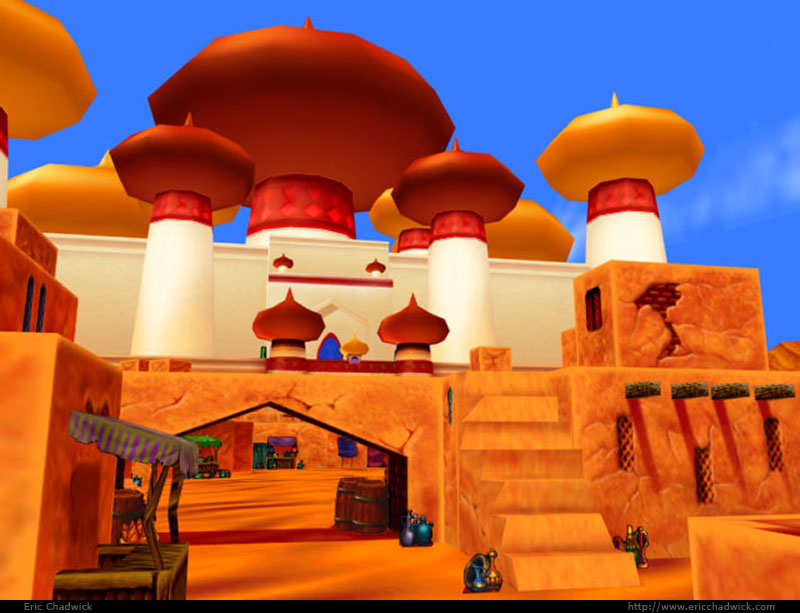
I directed nearly everyone in the whole team at one time or another in creating the main city environment of Agrabah, seen above.
This was the first environment in the game, and it was DI's constant desire to have a very rich 3D environment. They wanted to make sure the world was populated with plenty of unique elements, which led to it being divided into six separate load areas in order to fit the giant thing into memory. Except for a few boss characters, there was no lighting in the game so all the shadows and highlights are painted in.
The city went through several major revisions, ending with this particularly intense color scheme. After months working on Agrabah, it felt like we were stuck in the bottom of a big bag of Nacho Cheese Doritos.
Cave of Forty Thieves
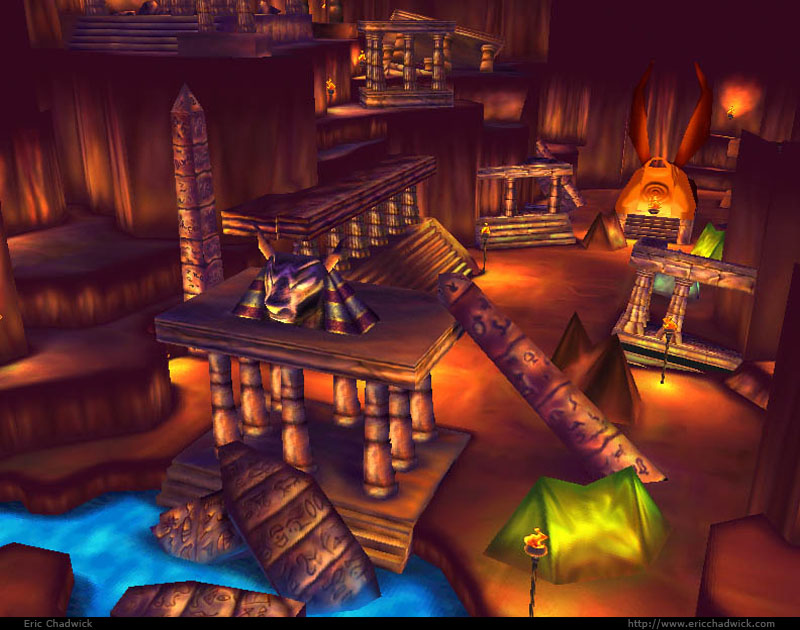
I directed two artists in modeling and texturing the Cave of Forty Thieves (above), while also helping to create some of the pieces. By carefully working out a system of interlocking wall textures, I tried to make it feel like you're seeing a lot of variety, yet we were working with a small number of separate textures.
Most of the stone columns are actually sprites with depth. This technique helps to hide the usual problem with sprites where they look strange when viewed from above, since they are usually just flat cutouts. The columns are three-sided so they actually wrap around slightly, giving them some curvature where they meet the floor, yet they still share the low-polygon advantage of regular sprites.
Jasmine's Room
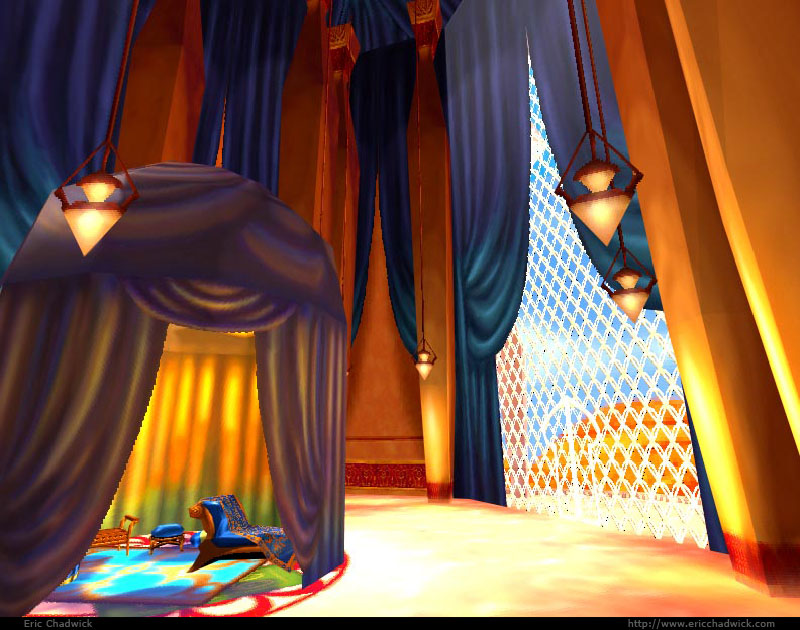
I directed another artist in modeling and texturing Jasmine's room in the palace. None of the textures are larger than 256 x 256, yet we were still able to pull out a decent amount of detail.